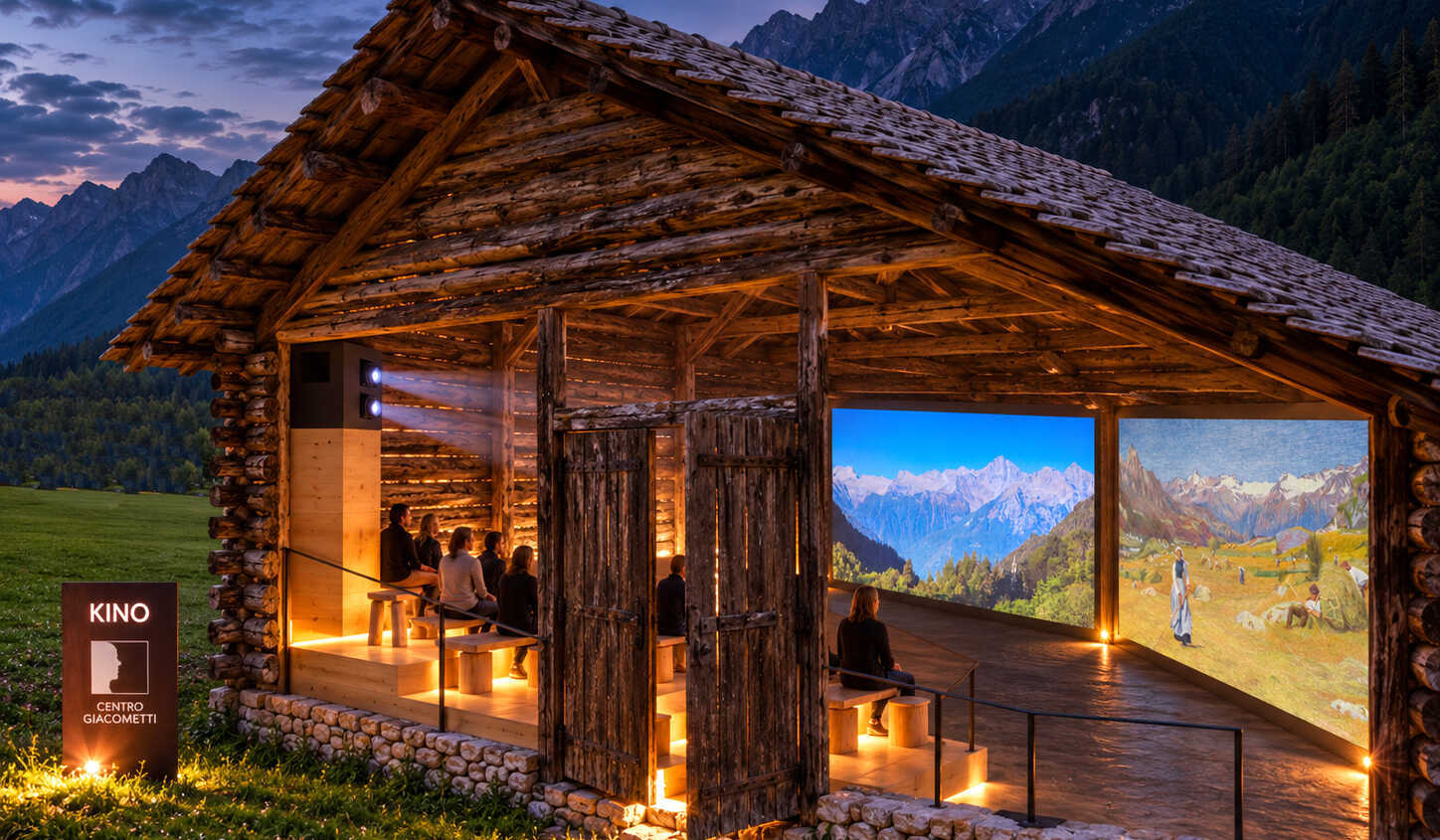
Mountain paintings and the real mountains of Bregaglia and the Upper Engadine in dialogue
Objective: An immersive video installation introduces audiences with an interest in art and mountains to the rich and diverse body of paintings by the Giacometti family of artists, deeply rooted in Bregaglia, as well as by Giovanni Segantini and Peter Robert Berry IIa.
Watch the video
The visual narrative, presented in a cinematic setting, brings the striking diversity of mountain landscapes depicted in drawings, watercolors and paintings into dialogue with the Alpine landscape itself. The installation thus combines an artistic and a nature-based experience, encouraging tourism that is both nature-oriented and culturally engaged.
The planned video installation complements the permanent exhibitions on the Giacometti family of artists, which have been on display at the Centro Giacometti since 2026. It places the special relationship between art, landscape and cultural identity at the center of the experience, strengthening the profile of Bregaglia and the Upper Engadine as destinations for both culture and nature.
In terms of both content and location, the video installation is ideally connected to the Sentiero Giacometti, developed in collaboration with Bregaglia Maloja Turismo. It thus becomes part of a cultural offering rooted in the region, linking the exhibition visit with the exploration of the surrounding landscape and appealing to hikers as well.
Visitors are encouraged to seek out the mountains depicted in the artworks on their own hikes and experience them at first hand. The project therefore creates additional incentives for visitors to extend their stay in the region and return at a later date, thereby contributing to the local economy.
Concept: An Immersive Video Installation in a Historic Hay Barn in Stampa
Between 1890 and 1965, Giovanni, Augusto and Alberto Giacometti, together with Giovanni Segantini and Peter Robert Berry II, depicted the mountain landscapes of Bregaglia and the Upper Engadine in numerous paintings and drawings. The diversity of their artistic explorations of the Alpine landscape, and the connections between their works and specific locations, have so far only been explored and presented together to a limited extent.
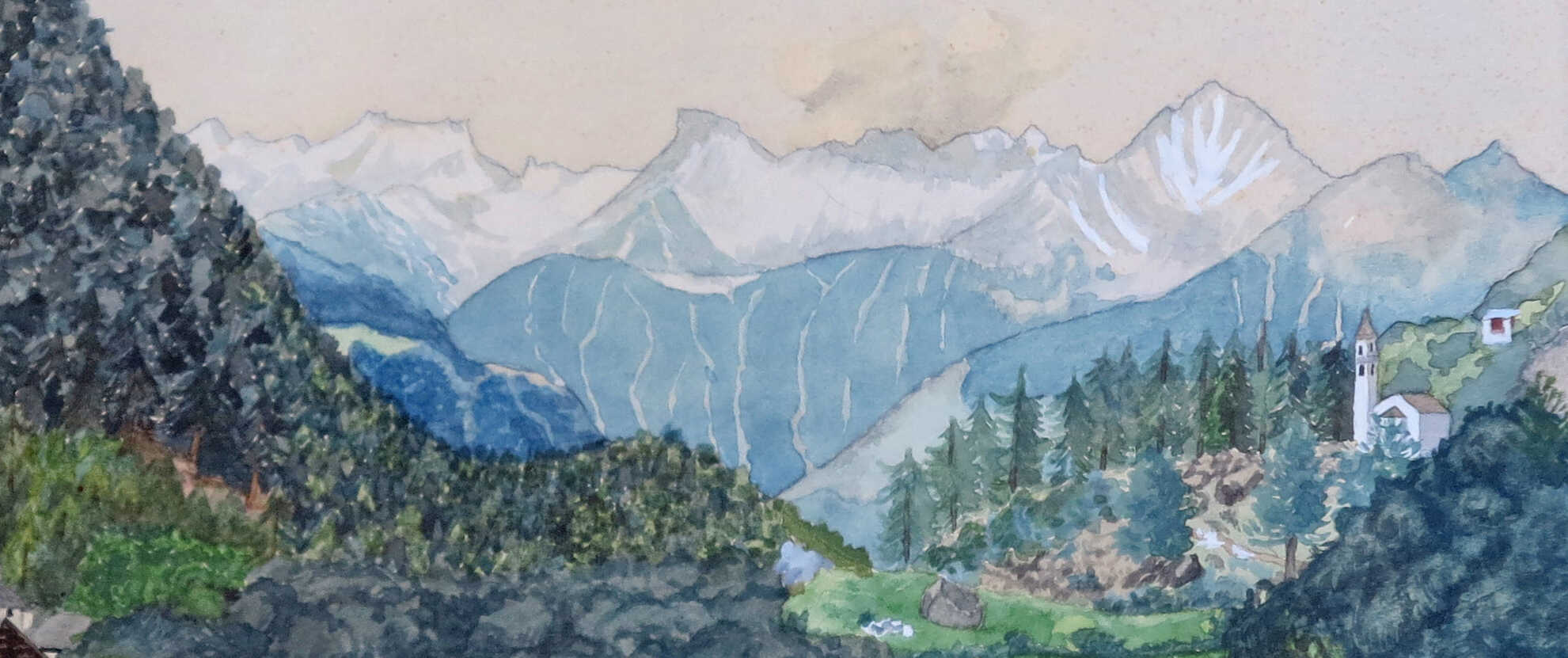
The planned immersive video installation brings a representative selection of these works into a new dialogue with the mountain landscapes of today. Across a large projection surface, high-resolution images of paintings and drawings are combined with contemporary film footage and photographs of the Alpine landscape, historical images and footage of mountaineers. Interviews, spoken texts and music complement the visual impressions, creating a rich, atmospheric and multi-layered experience.
This approach reveals surprising connections between the landscapes depicted by the artists and the mountains as they appear today. The mountains remain, but natural events and human activity have altered their appearance in some places.
The juxtaposition of painted and contemporary landscapes opens up a multi-layered exploration of the region’s natural and cultural heritage. The installation offers visitors insights into how the artists perceived and interpreted their surroundings. At the same time, it sparks curiosity to visit the places depicted and experience the mountains first-hand.
Barn Martinenga, Dating Back to 1492
A special feature of the project is the historic barn Martinenga in Samarovan, near Stampa. Dendrochronologically dated to 1492, this traditional hay barn becomes, through the video projection, a meeting place for art, nature and history. The installation offers new perspectives on the mountains that have inspired artists across generations and invites visitors to connect artistic representations with their own memories and experiences of the natural world today.
The video installation could be complemented by a presentation on the history and construction of the barn. Stall Martinenga is considered the oldest preserved barn of its kind in Graubünden. It was recently extensively restored under the direction of the Graubünden heritage conservation authorities. In this way, the historic building itself becomes part of the narrative of the region’s cultural heritage and landscape.
Narrative
The concept for the narrative is based on the large number of landscape paintings created by the Giacometti family in Stampa, Maloja and the Upper Engadine. Some of these works are now displayed in museums and exhibitions, but often in isolation from their original geographical and historical context. The vast majority, however, remain unknown to the public. The installation makes this rich and diverse body of work accessible on an unprecedented scale, bringing the paintings into dialogue with the mountains, valleys and settlements that inspired them.
The journey begins at the Graubünden Museum of Fine Arts, with a selection of mountain paintings by Giovanni, Augusto and Alberto Giacometti, as well as Giovanni Segantini. From the paintings, a geographically structured journey leads through the Upper Engadine and Bregaglia, discovering the landscapes that inspired the artists. Panoramas, colours, perspectives and artistic abstractions combine to create an immediate encounter with the Alpine world.
Crossing the Julier Pass and travelling through the St. Moritz region, the journey leads to the places where Giovanni Giacometti developed his work as a mountain painter under Segantini’s influence and exchanged ideas with Peter R. Berry II. In Maloja, we revisit Segantini’s final years and the growing presence of the Giacometti family in Bregaglia. Paintings by Giovanni and Alberto open up the mountain landscape stretching between Lake Sils, Piz Lunghin, Piz Lagrev, Corvatsch, Piz da la Margna and the peaks of the Forno region. Geological insights also help explain the formation and distinctive range of colours found in the Bregaglia landscape.
From Stampa, the mountain world unfolds in the four cardinal directions. To the east, the panorama is defined by the mountains’ distinctive profiles and granite towers. To the south, the view crosses steep, shadowed slopes towards Piz Grand and Val Bondasca, where painting, drawing, watercolour, photography and mountaineering offer different perspectives on the inaccessible peaks. To the north rises Piz Duan, overlooking the traditional mountain pastures and the Maira Valley. Here, geological insights intertwine with memories of an earlier way of life, when children grew up helping their families on mountain farms. To the west, the horizon opens towards the distant Lepontine Alps and the landscape around Gordona, accompanied by Alberto’s text Eyes on the Horizon and the perspective of a contemporary painter.
The video, exploring the theme of mountains in art, lasts approximately 30 minutes and is available in German, Italian and English.
Technical Specifications
The technological foundation of the installation is a large-scale projection system featuring a screen measuring 11 meters wide and 3.5 meters high. The images are projected using two high-performance projectors, each delivering 13,000 lumens of brightness. In parallel, a dedicated audio system enhances the visual experience with a precise and immersive acoustic dimension. The audio system is based on four passive speaker arrays installed throughout the space: on the left and right sides, as well as centrally above the screen. The system is complemented by a touchscreen interface integrated into a freestanding column with a built-in display. Through this interface, visitors can select their preferred language, choose whether to listen through the room's loudspeakers or via headphones, and start the presentation simply by touching the corresponding preview image.
All system components are housed in a specially designed, climate-controlled protective enclosure. This all-weather central equipment cabinet regulates ventilation while the projectors are operating and protects the equipment during the winter months through an integrated heating system. In addition to the two projectors, it contains the film playback and control system, the audio amplifiers for the speaker arrays, and various operational monitoring sensors. An integrated mobile network router, connected to an external antenna directed toward the Bregaglia mobile communications antenna, enables continuous remote monitoring of the entire installation, allowing technical issues to be addressed quickly and precisely whenever necessary.
The building's technical infrastructure is completed by an automated LED lighting control system. Motion sensors automatically switch on the lights when visitors enter the room. Once the film begins, the lighting is automatically dimmed to create optimal contrast conditions for viewing the projected images.
Production and Realization
- Producer: Fondazione Centro Giacometti
- Concept, script, digital files, paintings and historical photographs: Marco Giacometti
- Landscape filming, interviews, film editing and narration: Fernando Tiberini, Castasegna
- Drone footage: Margot Schneider, St. Gallen
- Mountain photography: Gianpiero Mazzoni, San Marco per Albaredo, Marco Giacometti and others
- Technical implementation, control systems, video and audio equipment, surveillance system: mld AG, Inwil
- Carpentry: Nusser AG, Vicosoprano
- Owner of the barn: Antonio Giacometti, Stampa
Financial contributions secured to date:
CHF 10'000 Ernst Göhner-Stiftung
CHF 3'000 Amici del Centro Giacometti
Anyone interested in participating in the project is invited to contact Marco Giacometti: